
Labor Day Weekend
Roy wanted to go agate hunting, and fishing. So, we loaded up the Dodge Ram pickup, hooked the 17-foot boat to it and set off for Lake Superior. Along the way we stopped at a couple of garage sales and Roy got a deal on some tools that happened to come in handy later. We also stopped a couple of times along the side of the road so Roy could look for agates by the road and in the soybean fields. At one point I was sitting in the truck alone and a policeman peered into the window to ask me what was going on. I pointed to Roy up ahead and off he went to tell Roy that parking by the side of the road like that was a hazard and we should move on.
We arrived in Ashland at the southern tip of Chequamegan Bay south of the Apostle Islands. We wandered around town and found a boat landing but the water was choppy and there weren’t any other boats out, so we decided to stay on land. Roy decided to go agate hunting in the water. He was wearing his rubber boots, thinking they would protect him from the water, but they didn’t. They soon filled up with water from the waves and he was sloshing around in four inches of water. He kept them on, though, in order to protect his feet from the rocks. He got soaked. All the way up past his crotch. It was cold and windy and I was freezing. I don’t think Roy found many agates. He ended up stripping in the parking lot and putting on a pair of shorts.
As we drove through town, Roy saw a sign for a garage sale. We went by the sign once and circled around to see it again to read the address. I didn’t see the sign.
“The sign is right there, bright green sign”, Roy was getting frustrated with a smile on his face. “Good god girl, it is right there, you can’t miss it, bright green”.
I was looking all over for it but didn’t see it. On the third time around I finally saw it resting on the ground. Roy gave me shit for that one. I laughed my ass off when I finally saw it.
We never did find the garage sale.
We stopped for dinner in a local restaurant and ordered some burgers. The place had paintings on the walls by a local artist, and they were priced at $300-350 each. Roy was very interested in this since he is an artist. We decided his art was as good or better than these and he should keep those prices in mind. After dinner we found a big pier where Roy did some fishing and I took pictures and walked to the end of it.

As we were heading out of town we came upon a nice little beach and thought it might be a good place to spend the night, but people kept showing up and it proved to be a pretty popular place so not a good overnight option. Roy did some more agate hunting along the beach but we didn’t stay too long. I enjoyed the sunset.
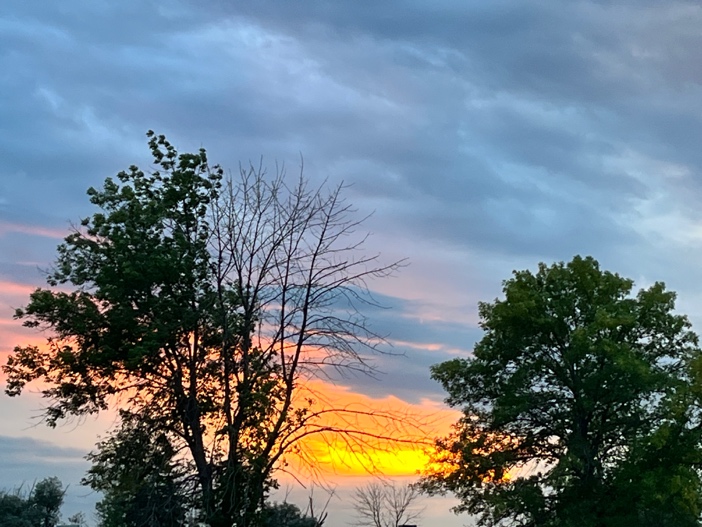
We then headed north towards Washburn on the west side of the bay. About 9 pm we stumbled on a nice marina and decided to park in their lot. It was a good place to spend the night. There was a topper on the pickup so we could hunker down in there. We cleared out the back, and I went to get the pillows from the truck. The door was locked. All the doors were locked. The keys were clearly visible in the ignition. This was bad.
We spent several minutes thinking about our scenario. Did we have to break a window? Was there anybody we could call? What to do? What to do? Finally, Roy pulled out his phone and googled ‘how to break into a 2014 Dogde Ram pickup’.
Roy had to pry the upper right-hand corner of the driver’s door out to be able to get a tool in to unlock it. This proved to not be an easy task. He tried different tools including different sized screwdrivers. When he got it to start coming out, he slid the screwdrivers down into the narrower part to force the door out more. Then he stuck bigger screwdrivers to get it wider at the top. At one time he padded things and put a hammer in to pry it open. He got a broken fishing pole that he had in the back of the truck and used it to get in from the top of the door and tried to push the button that activates the door lock. After many attempts he finally got the pole to hit the button but the pole was too flexible and when he pushed on it the pole would just bend and did not activate the switch. So, he decided to break the pole off so the end would not flex so much. It ended up that he broke the pole off about an inch too short so he couldn’t reach the switch with the pole.
After a lot more work trying to pry the door open further, he changed his target to the knob on the top of the door since it was closer. The knob was like a pencil, just straight on the edges and there was nothing to get a hold of. He decided to try and slip the end of his fiberglass fishing pole which was hollow on the inside over the knob. But the hole was too small, it would not go over the knob. He ended up taking some pliers and pinching the end of the rod to break the fiberglass just enough that the hole would expand over the knob. It was still holding tight enough that he was able to pull up and unlock the door. The fishing rod that was broken worked like Chinese handcuffs. The elation that we experienced was animated. We were very happy. Unbelievably we were able to get into the truck just as it was starting to rain. What timing!
After we got the truck open and settled down for the night, the rain continued and got worse. We were sleeping in a 5 ½ foot box that was a little short for Roy so we had to scrunch up diagonally. The back window needed to be open a sliver to keep the box from steaming up so my feet got a bit wet. It was a torrential rainstorm with thunder and lightning. It went on and on. Once it stopped, I had to pee, so I trudged out of the pickup, somehow got my shoes on, and squatted behind a truck in the parking lot. Back in bed, it started to rain again and we had another thunderstorm. By dawn the rain was gone but it was still overcast. We could hear people arriving to launch their boats and we just blended into the situation. Nobody the wiser. At this point I noticed there were toilets at the other end of the parking lot. Oh, well…. No need to squat in the parking lot after all.
After a quick run for coffee and donuts, we were ready to go fishing.
We got the boat in the water and set off. Roy was still looking for agates along the coastline, but nothing looked promising. We cruised around an island and underneath the water were cement pillars coming up to just a couple feet below the surface. It seemed like there was some kind of structure under the water. We were worried we would hit something under the water and pulled the motor up to say as clear as we could. It was very weird and kind of eerie. We managed to get clear of that area and after a while we headed north to the opening of the bay and spent a long time fishing near to shore. I took a lot of photos. Roy pulled out his watercolors and painted for a while. We watched a couple of big sailboats pass us by. It was a lovely day. How many fish did we catch? None.


Back at the marina Roy went off to get the truck and I tried to get out of the boat. I tripped and fell flat on my face. I thought I broke my nose. I just lied there on the dock for a long time. A couple of people came over to see if I was okay. A guy looked at my nose and said it wasn’t bleeding and didn’t look broken so that made me feel better. I was in a lot of pain. Roy came back and said he hadn’t seen me fall and was concerned about me. I thought I could get up and he tried to help me, but I just fell right back down. I just sat there for a while until I felt better, and he and another guy helped me get to my feet. It turned out okay. No serious damage done. Although I did have a red nose for a day or two.
We decided to head for Wisconsin Point in Superior, Wisconsin because Roy thought there would be agates on the shore. Driving through Bayfield we noticed an ice cream place, so we stopped. Two old ladies served us some decent malts. We came across a small garage sale on a side road where they were giving away foodstuff for free. Roy snagged a bunch of canned tomato products, but I said he should leave the other food for people who were more needy. He agreed. He said he was going to make enchiladas with the canned tomatoes. Bayfield was packed with people. The ferry leaves from there to Madelaine Island. Lots of tourists.
A ways up the shore we stopped at a secluded beach and Roy started looking for agates. He was digging into the sand and throwing up rocks for us to look at. He was wearing shorts so didn’t get his clothes too wet, but I got into it and my pants were soaked. There were some pretty good waves hitting the shore. I got tossed around a bit. We came away with a pile of rocks to take home, hoping some were agates. From there we stopped at a gas station so I could change my pants since I was very cold.
When we reached Superior, we searched for pizza places and found one not too far from the turn off for Wisconsin Point. We had a decent pizza and played a game of pool. Roy beat me but just barely. We were pretty evenly matched. Which is saying neither one of us was very good.
It was pitch dark when we reached the point. It is a large park on a finger of land that juts out at the far end of Duluth harbor. There are several beaches and parking lots. We found one with a toilet which made me happy. We were just settling down in the back of the truck when we heard car after car pull up and kids yelling at each other, flashlights beaming all around. They seemed to be ready for some Saturday night partying at the beach. We later discovered they built a fire and drank beer and had THC vapes and did who knows what else. And they left all their trash on the beach. We cleaned it up next day. Luckily, they didn’t bother us. We didn’t hear them leave since we were asleep by then. Then early in the morning other cars started to show up and we couldn’t figure out why they were there or what they were doing. Turns out we think they were going to walk their dogs on the beach.
We got up and ate some cold pizza and headed for the beach. Roy put on his swimsuit and started digging for agates. It was cold and windy and overcast and the water was very muddy and choppy, but he was determined. He spent several hours searching for his agates. Digging in the muddy water and throwing rocks up on the beach so we could see them.


When we first got there, we saw a large ship on its way out to sea.
After he again stripped in the parking lot and dried off and put some clothes on, we decided to go bowling. We hit another garage sale on the way to the bowling alley. Roy won two out of three games and then he played a couple more on his own.
As we were leaving the parking lot we noticed the brakes were starting to make a lot of noise. The brakes got progressively worse. It sounded like metal on metal and then we lost the brakes completely. We were trying to keep as much distance as we could from the car ahead of us while we looked for a place to safely stop. We limped into a gas station and checked the brake fluid. It was very low so we bought some and poured it in only to watch it drain out on the pavement. We knew we needed to fix the brakes and in order to do that we needed an auto parts store. We inquired but the nearest one was a couple of towns down the road. We drove through two towns with no brakes and managed to roll into the parking lot of the auto parts store without hitting anything.
We had to get the front wheel off the truck in order to get to the brakes. The wheel did not want to come off. Roy banged on it, cajoled it, pried it and did it all again. The thing would not budge. We had borrowed a jack from the store and needed to return it by closing time so we were running against the clock. The auto parts employee was very helpful and brought out a mallet that we bought in order to bang on the wheel some more. Between the mallet and one of the tools we got earlier at the garage sale, it finally popped off. That was a relief.
Once the wheel was off we determined the leak was not coming from the hose but from the caliper. We figured the heat from the metal on metal grinding had destroyed the rubber seals in the caliper. We then purchased all the parts to change to caliper and put new pads on. It was an hour and a half till closing time and starting to get dark, so we were racing against time. The auto parts employee helped put the pads on the caliper and get it ready to put onto the truck. It was dark out by this time, around 9:30 pm. We managed to get it all put back together by closing time. Just barely. We should have bled the brakes but did not want to push our time in the parking lot. So we took off with the brakes semi working.
They were still making some noise, and we wondered if the auto parts guy who was helping us put the pads in correctly. It seemed like something was still wrong. We were able to limp along and decided to push for home.
Roy was starting to fall asleep, but I wanted to get home so I offered to drive. It was very dark out with no streetlights or many people around. Roy asked where the root beer was and I was trying to tell him it was in the back seat in the middle. He was reaching around to find it and apparently, I missed the warning sign for an upcoming intersection. All of a sudden there was a stop sign in front of me. I slammed on the brakes, but my foot went all the way down to the floor and nothing happened. I started to pump them but realized the intersection was a ‘T’ section and there was no road ahead of me. I had to swerve to the left and hope there were no cars coming. I continued to pump the brakes and right ahead of me was a road sign. All I could think of was “don’t hit the sign, don’t hit the sign, don’t hit the sign”. The truck stopped two inches from the sign. I breathed a sigh of relief. We were okay, the truck was ok.
Roy got and looked behind us. The boat was upside-down in the ditch. He flipped out chanting “My fucking boat, my fucking boat, my beautiful fucking boat!!” as he paced up and down the highway. Very upset. I just stood there unable to move. Eventually he calmed down a bit and came over and hugged me. He never showed anger towards me or yelled at me. He just said, “shit happens”.
I called 911 and tried to explain to the operator where I was. I had not idea. After a while a policeman showed up and asked us a bunch of questions, looked at our licenses and called a tow truck. He said he was not going to give me a ticket since nobody else was involved and nobody was hurt. The tow truck person was able to get the boat turned over and back on the trailer and hauled it over a nearby parking lot. We left it there and would return in the morning to assess the damage.
The amazing this was that with all the mishaps and the things that went wrong, neither one of us ever lashed out or lost it. There was zero drama. It was just a really fun weekend.


