russia

Equality for women is progress for all

240px-Frauentag_1914_Heraus_mit_dem_Frauenwahlrecht

“Countries with more gender equality have better economic growth. Companies with more women leaders perform better. Peace agreements that include women are more durable. Parliaments with more women enact more legislation on key social issues such as health, education, anti-discrimination and child support. The evidence is clear: equality for women means progress for all.”

Secretary-General Ban Ki-moon


The United Nations theme for 2014 International Women’s Day is “Equality for women is progress for all”.

In 1908 15,000 women marched in New York City to demand better working conditions, more pay, and the right to vote. This was the birth of the woman’s movement. In 1911 more than a million women marched throughout Europe to end discrimination. On March 25th of that year 123 female garment workers aged 16 to 23 died in a fire in New York City. Many fell or jumped to their deaths to escape the fire. The doors were locked. Most of them were Italian and Jewish immigrants. The outcome was legislation mandating better working conditions.

180px-8marta

The first Women’s Day was held in 1911 and in 1914 March 8th became the official International Women’s Day.  In 1917 the women of Russia staged a protest for “Bread and Peace” in response to the death of over 2 million Russian soldiers. They protested for four days until the Czar abdicated and the provisional government granted them the right to vote. Their protest started on March 8th.

Over the years the movement grew and today 27 countries around the world celebrated March 8th as an official holiday. Women in the 1970’s again rose and fought for women’s rights and equality. In the West much was accomplished and women entered the workforce and gained more equality and legislative rights.

However, there is still considerable inequality. Women do not have equal rights or equal pay. Many women around the world are still dealing with forced marriages, slavery and horrible working conditions. In 2012, 257 people died in a textile factory in Pakistan. It is suspected the doors were locked.

In Russia March 8th is a big deal. Women receive flowers and small presents. Families gather for celebrations. Everybody has the day off work. It is nice.

But it is also a time to reflect on how much more there is to do. Look out for your sisters, mothers, daughters and friends.

Happy Women’s Day!

Food Friday: Easter Kulich

The first time I saw a Kulich was in Boston. My boyfriend’s mother was a Byelorussian who had grown up in Paris and emigrated to the USA as a teenager. Her mother still lived in New York but would come to visit from time to time. She only spoke French and Russian. Nobody could communicate with her except her daughter. One of her visits she brought a Kulich she had made. I was interested in it and would have loved to taste it but I never got the chance. I didn’t even know it as a Kulich because I couldn’t talk to the woman.

Ten years later I hooked up with another Russian American, this time from Milwaukee who kept raving about Kulich. His mother would send it to him at Easter and he would savor every bite. He would heat it and spread butter on it. I wasn’t that impressed with it. I thought it was dry and kind of bland.

Ten years later I was living in Moscow, Russia, and submerged into the people and the culture. I discovered Russian bakeries and the variety of Kulich available. It had grown on me. I now looked forward to Easter and picking out the best Kulich I could find. I loved to bake and cook but I never had the courage to make a Kulich. It seemed to me it should be produced by a grandmother in order for it to be really good.

Back in the USA, I toyed with the idea of making Kulich. I missed it. And then I discovered a Russian store in the area. In the beginning they sold the cakes made by local grandmothers. Now they sell mass produced packaged Kulich made in Brooklyn. It’s not quite the same.

This year Russian Orthodox Easter falls on Sunday, May 5. They still go by the old Julian calendar so everything is later. You have plenty of time to make your Kulich!

Kulich is a cross between a bread and a cake. It has a lot of eggs and usually some raisins and can have other dried fruit in it. It is always round and should be placed upright on the table. It is sliced in rounds, across the cake, the top being taken off to be saved and then put back, like a lid, on the part that remains. Some of the fancier ones have a glaze frosting on top that drips down the sides.

People in the US can use old coffee tins to bake in or any round tin with an open top and closed bottom will do. You can use regular cake pans but you should try to somehow build up the sides so it has some height.

KULICH

2 cups scalded milk

¼ cup sugar

2 packages yeast

3 cups flour

Cool milk to lukewarm. Dissolve yeast and sugar in milk. Add flour and beat well. Set covered bowl in warm place until bubbly and very light (about 1 hr).
3 eggs

½ cup melted butter, cooled

2 ½ cups flour

1 cup raisins

½ cup sugar

1 teaspoon salt

Beat the eggs well with the sugar and salt. Add to the sponge which has been rising. Add flour and knead well. Knead in raisins. Let rise until light.

Knead down and shape into loaves. If you are using coffee cans, be careful not to use too much dough. Let it rise again. This makes 2 large (larger than a coffee can) loaves, although the size depends on how much you let it rise.

Brush top with glaze of 1 egg yolk beaten with 1 ½ tablespoons water (optional).

Bake in 350 degree oven for about 30 minutes. Tap and listen for hollow sound to test for readiness.

Cool 5 minutes on rack then remove rom pan and continue cooling on rack.

To glaze: Mix confectioner’s sugar with water until it is a paste and pour it over the top, letting it drizzle down the sides. Sprinkle slivered almonds or candy sprinkles over the glaze.

Food Friday: Women’s Day and Pirozhki

FoodLogo


IMG_1265


March 8

Happy International Women’s Day!!


In Russia International Women’s Day is a big deal.  Everybody gets the day off!  Women receive flowers and chocolates and have a day of rest.  The day before, co-workers give presents and have parties bringing cakes and snacks to work.  One yummy snack the Russians make is Pirozhki.

These are small pies made with bread dough.  They can be eaten as a snack, a light lunch, or an appetizer.  This is the traditional version, however, my mother in law taught me a shortcut.  Here in the USA, she buys the Pillsbury Grand biscuits in the refrigerated section of the super market.  She splits each biscuit dough section in half, flattens it out, puts filling in it, and folds it over.  I have to admit, it is much easier!  But the real thing always tastes the best.


Basic dough

1 package active dry yeast (1 Tbsp.)

1/4 cup warm water

1 cup milk

8 Tbsps. butter, cut into bits

1 tsp. salt

2 tsps. sugar

1 whole egg

2 egg yokes

4 1/2 to 5 cups flour

1 whole egg, beaten

Yield: 4 dozen

Dissolve the yeast in the warm water. Heat the milk to lukewarm and add the butter to it. Stir the milk and butter mixture into the yeast. Add the salt, sugar, egg and egg yolks, mixing well. Gradually stir in enough flour to make a soft dough.

Turn the dough out onto a floured board and knead it lightly until smooth and elastic. Place in a greased bowl, turning dough to grease the top, and cover with a clean towel. Let rise in a warm place until doubled in bulk, about 1 1/2 hours.

Punch down the dough and divide it into 48 balls of equal size. On a floured board roll each ball out to a circle 3 1/2 inches in diameter.

IMG_1261


Place a heaping Tbsp. of filling on each circle, then press the edges of the dough together firmly to seal. Gently shape the pies into elongated ovals.

IMG_1262


Place the pies seam side down on a greased baking sheet. Cover and let rise until they are just doubled in bulk, about 40 minutes.

Preheat the oven to 350°F.

Brush each pie with the beaten egg. Bake for 20 minutes, or until golden.

FILLINGS

Beef

2 large onions, minced

IMG_1257


2 Tbsps. butter

1 lb. lean ground beef

2 tsps. salt

pepper to taste

IMG_1259


Sauté the onions in the butter until transparent. Stir in the beef and cook until done. Add the remaining ingredients, mixing well. Cool.

Cabbage

4 Tbsps. butter

2 large onions, minced

1 lb. cabbage, finely shredded

1 tsp. dill

2 tsps. salt

pepper to taste

Sauté the onions in the butter. Add the cabbage and continue cooking for 15 to 20 minutes more, until the cabbage is tender but not browned. Stir in the remaining ingredients. Cool.

Mushrooms

2 Tbsps. butter

2 medium onions, minced

1.5 lbs mushrooms, chopped  (wild or tame)

6 Tbsps. minced fresh parsley

2 tsps. fresh dill

salt and pepper to taste

Sauté the onions in the butter until soft but not brown. Stir in the mushrooms and cook for 5 minutes more. Remove from the heat and stir in the remaining ingredients, mixing well.

IMG_1264


Cool and Enjoy!


It’s always something

snl-10


The first year Saturday Night Live aired on TV in the USA, Gilda Radner was part of the cast. She played several different characters, but my favorite was Rosanne Roseannadanna. This character did a “commentary” on the nightly “news” show. She would go on and on about some stupidity somebody had done and then focus on some very disgusting detail and Jane Curtain would put an end to it all saying it was making her want to throw up. Rosanna would end the skit by saying Well, Jane, it just goes to show you, it’s always something! If it’s not one thing, it’s another!

About 10 years later Gilda was diagnosed with ovarian cancer and died three years later in 1989.

My ex-husband, Nicholas, always had a great sense of humor and loved Saturday Night Live. Rosanna was one of his favorites, too. As well as John Belushi, Samurai Delicatessen.

I met Nicholas when I was living in Minneapolis, MN. He was a left radical who passionately believed in living green before anybody thought about it much. He wanted to be a writer. He grew up speaking Russian at home and had just returned from Nicaragua where he was learning Spanish and following the Sandanistas around taking photos. He was anything but boring. We dated for four years and then married in December of 1988. We went to Cancun for our honeymoon but also visited Chichen Itza, Merida, and Uxmal. About a week after we returned, he left for a month in Russia. His first trip to the motherland. He met most of his relatives for the first time. He always wanted to live and work in Russia and it looked like it might be possible with all the changes coming about.

Nicholas started out his career as a journalist working for the Tampa Tribune and we moved to Clearwater, Florida, in 1989. That only lasted about a year. He was bored to death. He was supposed to be writing about environmental issues but they kept assigning him to local festivals and tourist attractions. Due to a strange set of circumstances we ended up in Washington DC and in 1991 he left for Moscow as a freelance journalist. He witnessed and reported on the coup of August 1991 when the Soviet Union fell. I heard him on NPR the day the tanks rolled into Moscow. He liked to live large, work hard and play hard. He loved to get out there in the thick of it. When Yeltsin was bombing the Parliament House in Moscow in 1993, Nicholas was out there in the crowd spotting snipers and running around the “war zone”.

During the 10 years that Nicholas lived in Moscow, he started an Expat List and and Expat Site. Both were forums and information hubs for expats living in Moscow. It was fun to see it grow over the years and to realize it filled a niche for much needed information. Although it has changed a lot since those days and Nicholas is no longer involved, it does still exist and people continue to use it.

Our son was born during this time and he spent the first six years of his life living in Moscow. After returning to the USA in 2002, Nicholas ran a program for exchange students and professionals from Russia and Ukraine. He enjoyed it but I don’t think he found it especially challenging.

Then somehow it all fell into place and he landed a great job. He developed, coordinated, and edited a news website for a Defense Department contract covering all the news for Central Asia. This website has been instrumental in counter terrorism activities in the area. The website is Central Asia Online.

He and I had our differences but we were married for 16 years and had some very good times traveling around Europe and dealing with the challenges of living in Russia. He tried to be a good father and stayed close to his son.

In April of 2011, Nicholas, had a seizure at work. They found a tumor in his brain and after it was removed they determined it was an aggressive form of brain cancer, stage 4. With the help of chemo he lived a pretty normal life for the next year. He had a very positive outlook throughout his illness and he added the  following signature to his emails:

Life’s journey is not to arrive at the grave safely in
a well preserved body, but rather, to skid in
sideways, totally worn out, shouting … “Holy
shit…what a ride!”

Then the chemo stopped working.

He and our son had planned a trip back to Russia for the spring of 2013. In August, 2012, the trip was moved up and they went for a two week visit. They saw relatives, friends, and many of their old stomping grounds. It was a dream come true for both of them.

A few weeks after they returned, Nicholas was in the hospital with rolling seizures. They tried several drugs and he was able to recover to a point. They gave him several different treatments to shrink the tumors but they just kept spreading. In December he was told to seek hospice.

Both Nicholas and Gilda had cancers that are difficult if not impossible to test for or discover early on. Because of Gilda’s high profile, there has been progress in ovarian cancer and a lot of money has poured into research in that area. They are even testing a vaccine that could help stop the recurrence after treatment.

Brain tumors and brain cancer have a long way to go, however. More research is needed.

Please help by donating to the cancer research fund. For more information and to donate click HERE.

It’s always something…..if it’s not one thing it’s another.

Nicholas Pilugin, August 17, 1955 – January 17, 2013

Food Friday: Beef Stroganoff

FoodLogo

IMG_0996


While living in Moscow, I coordinated, edited, and produced a cookbook for the American Women’s Organization.  I put in a section with Russian recipes and here is my entry for Beef Stroganoff:

IMG_1024


Beef Stroganoff

The story goes that Count Pavel Stroganov came from one of the oldest noble families of Russia.  He was a popular figure in French society at the turn of the century and, of course, he had a French chef.  This chef came up with the idea of adding sour cream to his mustard sauce and named it after his employer.  Not very romantic but quite tasty.

IMG_0998


1 1/2 lbs. tenderloin of beef, cut into strips 2 inches long and 1/2 inch thick

2 Tbsps. butter

1 small onion, sliced paper thin

salt, black pepper

2 Tbsps. butter

2 Tbsps. four

1 Tbsp. mustard (the spicier the better)

1 cup beef bouillon

1/4 cup sour cream

Parsley for garnish

French fries or Egg noodles

Yield: 4 to 6 servings

In a heavy frying pan melt the 2 Tbsps. butter and sauté the onion until soft. Add the meat all at once and cook over high heat for just a few minutes, until it is cooked through. Season with salt and pepper to taste. Set aside, but keep warm.

IMG_1004


In a small saucepan melt the remaining 2 Tbsps. butter. Mix the flour and mustard and whisk into the butter.

IMG_1009


Cook for a minute, then gradually add the bouillon, stirring constantly, until a fairly thick sauce has been formed.

IMG_1020


Stir in the sour cream, mixing well. Pour the sauce over the meat, check for seasoning and heat through, but do not boil.

I obviously don’t follow directions very well.  I did not use a small saucepan and I put the sour cream in last but it turned out okay anyway.

Spoon the meat and sauce onto a large platter (not a bowl) and garnish with parsley. Serve with french fries, or egg noodles.

Some recipes call for mushrooms or tomato sauce. Although they are tasty apparently they are not the original, authentic version.

Enjoy!

Food Friday: End of the World Cookies

FoodLogo


It’s that time of year again when time slips away and you don’t know if you are coming or going.  On top of that we had to deal with the end of the world.  But I think we can all breath a collective sigh of relief since as far as I can tell, the world hasn’t ended.  Thankfully the all knowing all seeing Vlad Putin has been kind enough to enlighten us:

“I know when the end of the world will come,” Putin said with his usual confidence during a press conference on Thursday. “When?” asked a nervous journalist. “In about 4.5bn years,” he replied. Sighs of relief were breathed across Russia.

That good news plus a tall cold vodka tonic made me feel much better about the world in general.  Then I realized it was Food Friday!  Yay.

All I could muster this week were some traditional Christmas cookies which I baked for my son to take over to his father.  It was my good deed for the week.  Luckily it comes with benefits as I can showcase them here.  For you.  Lucky you!

These are basic Christmas cookies.  If you don’t have cute cookie cutters, use a glass and make round ones.

IMG_0825


Sugar Cookies

2.5 cups flour

1 tsp baking powder

1 tsp cinnamon

pinch of salt

1 cup butter

1 cup sugar

2 large egg yolks

2 tsps vanilla

colored sugar for decoration

Combine dry ingredients.

Cream butter and sugar.  Beat in eggs and vanilla extract.  Blend in dry ingredients.

Cover and chill 1 hour.

Preheat oven to 375 degrees F.

Lightly oil 2 baking sheets.

Roll out dough on a floured surface to about one-quarter inch thickness.

Cut out cookies and place on the baking sheet.

Sprinkle with colored sugar.

Bake 9-11 minutes.

IMG_0826


Let cool.  I threw in a State of Minnesota cookie cutter just for kicks.  Can you find it??

IMG_0827


Eat!!

They aren’t fancy but they are functional and taste pretty good.

I’m heading out for the wilds of Wisconsin pretty soon here.  I’m hoping to see lots of snow!

Happy Holidays!!

Food Friday: Zucchini

FoodLogoIMG_0778


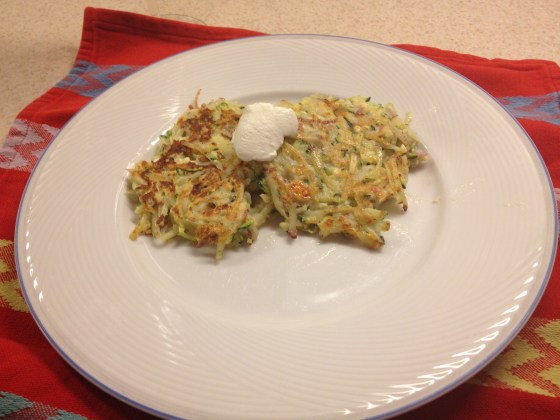
Potato pancakes were a family favorite in Russia when I lived there.  Russians love their potatoes.  They eat them cold in salads, boiled with meat, and fried.  I made up this recipe to make it a little more interesting.  This can be an entire meal or a side dish.

IMG_0771


Zucchini – Potato- Feta Pancakes

1 large zuccini (or two small to medium)  Grated

3 medium potatoes (any kind you happen to have around)  Grated

1 small red onion (I cut a big one in half)  Grated

3/4 cup Feta cheese – You can use either soft or crumbled

2 Eggs

4 Tbsp flour

Salt and Pepper

Sour Cream or Plain Yogurt

IMG_0772


You can grate everything by hand but it is much quicker and easier if you have a food processor.  Takes about a minute.

IMG_0774


Mix in the eggs, flour, cheese, salt and pepper

Salt would depend on how salty the Feta is, I would taste it first.  I use about 7 turns of black pepper.

IMG_0775

IMG_0779


Put some oil in a non-stick pan and get it good an hot.  Then put a generous spoonful in the pan and flatten it out.  It will take a while to cook.  Probably about 5 minutes on each side.  Then I put them in a glass place in the oven at 350 degrees F to keep them warm and let them cook a bit more.

Serve with sour cream or plain yogurt.

Enjoy!  За здоровье! (Za zdarov’e!)

Berlin: Soviet War Memorial

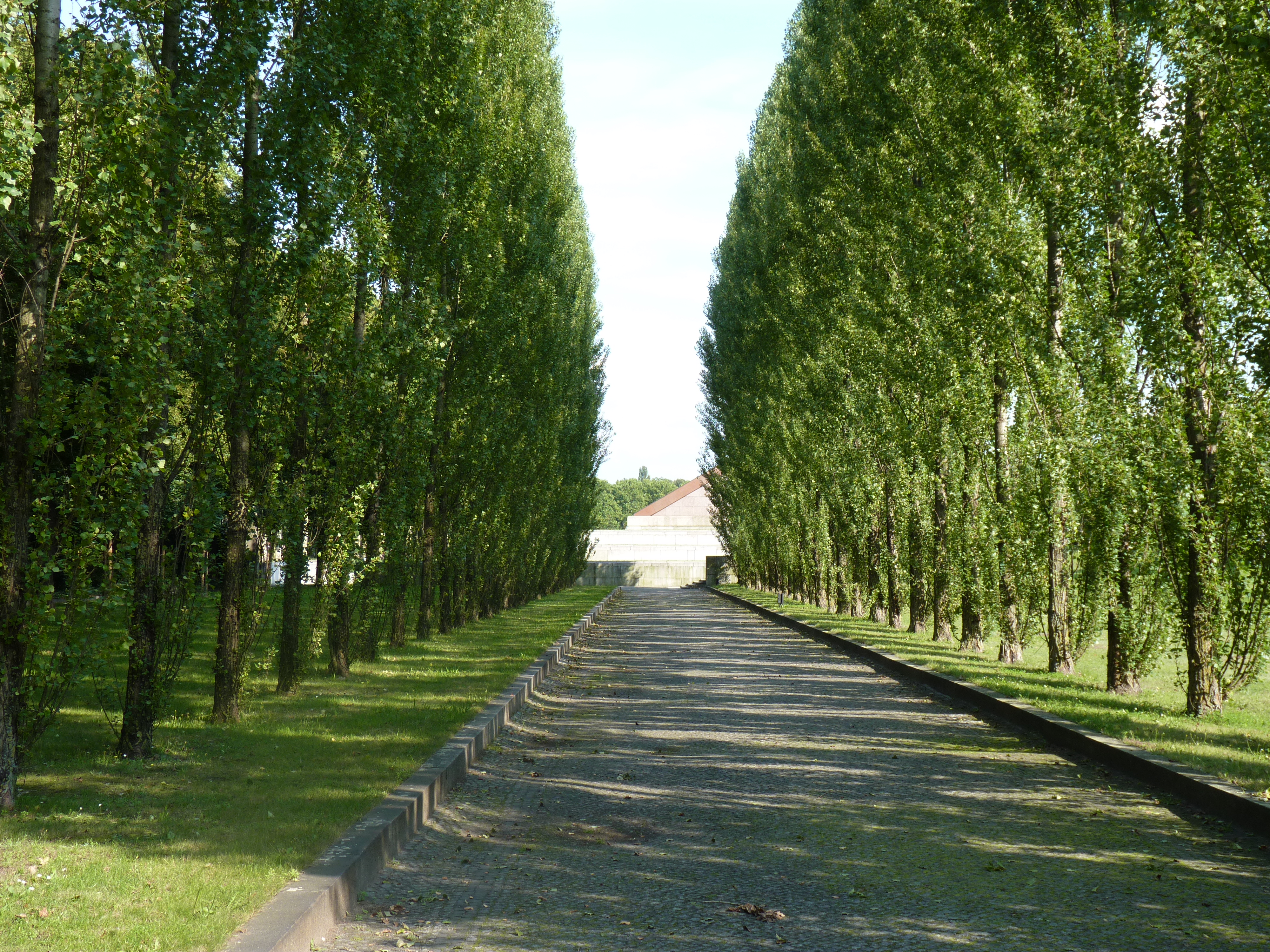
Entrance to Memorial from Treptower Park


The Battle of Berlin marked the end of World War II.  It took place April to May 1945 and claimed about 80,000 Soviet lives.  Stalin was in a hurry to take Berlin because he wanted to get to their Nuclear research facility before the Americans arrived in order to find out what the Germans had discovered.  The Soviet Nuclear program needed a boost.  Because Stalin was in such a hurry, mistakes were made and an enormous amount of Soviet lives were lost.


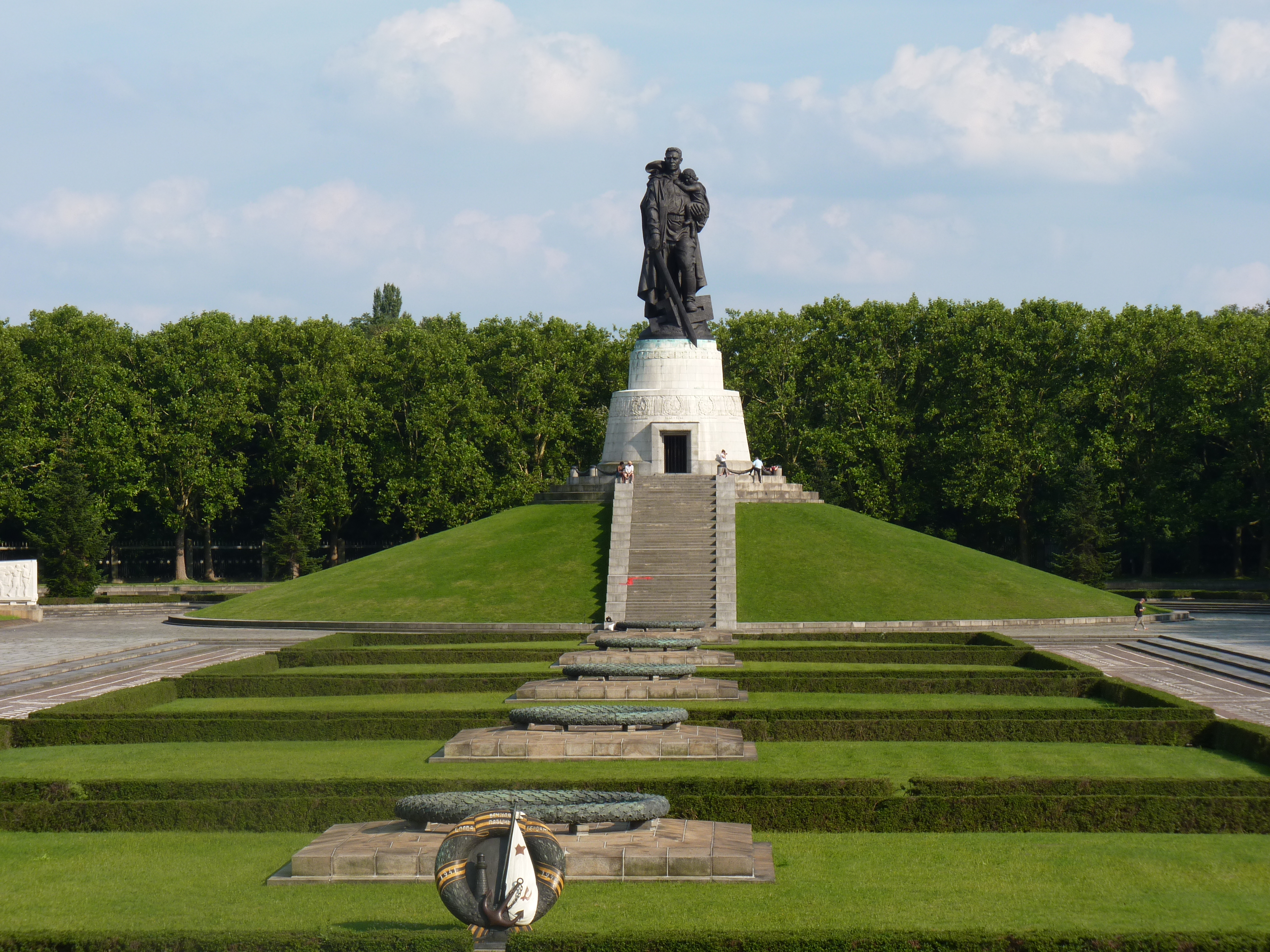
There are three memorials to the Soviet Troops in Berlin.  One is the Tiergarten Memorial near the Brandenberg Gate.  It is relatively small and compact and was built in 1945.  Another is the Schonholzer Heide in the Pankow district.  It was finished in 1949 and covers 30,000 square meters (98,500 sq ft).  The third is in the Treptower Park.  It opened in 1949 as well and was the main war memorial for East Germany.  Five thousand Soviet soldiers are buried there.

We visited on a warm summer day arriving after walking for miles and miles not knowing how far it was.  The park was lovely and the memorial was impressive, built to a grand scale.


Mother Russia weeping over her dead children


Leaving things behind

I am currently reading, Overseas American: Growing Up Gringo in the Tropics by Gene H. Bell-Villada.  It is a very personal account of a difficult childhood.  Throughout the book he quotes from other books about TCK’s and Global Nomads.

“The Absentee American belongs to no culture, or perhaps to all cultures… To the Absentee American, all countries, including the United States, are ‘foreign.’  By the same token any country can be ‘home.’ “– Carolyn D Smith, the Absentee American

“Reentry is a significant event for the Absentee American; the experience may be vividly recollected decades later.  Respondents described reentry as difficult, painful, turbulent, or traumatic… The experience is often referred to as a shock.. . In professional literature on the subject, this transition is generally referred to as euphoria, irritability, hostility, gradual adjustment, and adaptation.”  — Carolyn D Smith, the Absentee American

When I first saw these quotes, I went looking among my books for the Absentee American, Hidden Immigrants, Letters Never Sent, and Strangers at Home.  All books I knew I had read and was sure I had.  Then I remembered.  No I didn’t.

While I was living in Russia, I discovered there was a label for people like me – Third Culture Kid, or Global Nomad – and I wanted to read everything I could get my hands on about it.  I accumulated a small library and I poured over them and re-read them.  It was my great moment of self discovery.

My apartment in Moscow had a long hallway with floor to ceiling bookcases along one side.  They were full of books, music CD’s, videos, and a few knick knacks.  My special TCK books were prominently displays on those bookcases.

After almost nine years living as an expat in Moscow, we unexpectedly had to leave quickly.  My husband, son, and I landed back in the USA with six suit cases.  Everything else, all the things we had accumulated over nine years of life remained in Moscow.  At the time those things were the least of my problems.  I had never grown particularly attached to “things” and didn’t think much of it.  It is only now, ten years later, that I find myself thinking, “what ever happened to…?”  or  ” I sure wish I had….”.  Most everything was replaceable, of course, but some of these books in particular are now out of print, expensive and hard to find.  It would be nice to have them to refer to as I work on my book, but not necessary.

As Linda over at Adventures in Expat Land  says, flexibility is key!

Easter Kulich


The first time I saw a Kulich was in Boston.  My boyfriend’s mother was Russian and her mother brought over a Kulich at Easter.  Nobody seemed too interested in eating it so I never got to taste it.

Ten years later I had a different Russian American boyfriend who kept raving about Kulich.  His mother would send it to him at Easter and he would savor every bite.  He would heat it and spread butter on it.  I thought it was dry and not that interesting.

Ten years later I was living in Moscow, Russia, and submerged into the people and the culture.  I had discovered Russian bakeries and the variety of Kulich available there.  It had grown on me.  I now looked forward to Easter and picking out the best Kulich I could find.  I loved to bake and cook but I never had the courage to make a Kulich.  It seemed to me it should be produced by a grandmother in order for it to be really good.

Back in the USA, I toyed with the idea of making Kulich.  I missed it.  And then I discovered a Russian store in the area.  In the beginning they sold the cakes made by local grandmothers.  Now they sell mass produced packaged Kulich made in Brooklyn.  It’s not quite the same.  I may have to break out and make my own after all.

This year Russian Orthodox Easter falls on April 15.  They still adhere to the old Julian calendar so everything is later.  When I lived in Moscow, we celebrated the “Western” Christmas on Dec 25, New Year’s on January 1, and then the Epiphany on January 6, then two weeks later was Russian Orthodox, Christmas, then the old New Year, and finally the Russian Orthodox Epiphany.  It was a month of non stop celebrating.  And then a lot of recuperating.

Traditionally Russian families will spend Easter morning at the cemetery cleaning the graves of debris that has gathered over the winter.  They will place flowers on the graves or even plant them.  People sprinkle bread and boiled egg over the graves.  It is a time for families to be together and to retell stories about each other.

From the cemetery they usually congregate at somebody’s house for a large meal lasting several hours.  The meal more than likely will end with Kulich and paskha a sweet cream cheese.

Kulich is a cross between a bread and a cake.  It has a lot of eggs and usually some raisins and can have other dried fruit in it.  It is always round and should be placed upright on the table. It is sliced in rounds, across the cake, the top being taken off to be saved and then put back, like a lid, on the part that remains.  Some of the fancier ones have a glaze frosting on top that drips down the sides.

People in the US can use old coffee tins to bake in or any round tin with an open top and closed bottom will do.  You can use regular cake pans but you should try to somehow build up the sides so it has some height.


KULICH

2 cups scalded milk

¼ cup sugar

2 packages yeast

3 cups flour

Cool milk to lukewarm.  Dissolve yeast and sugar in milk.  Add flour and beat well.  Set covered bowl in warm place until bubbly and very light (about 1 hr).

3 eggs

½ cup melted butter, cooled

2 ½ cups flour

1 cup raisins

½ cup sugar

1 teaspoon salt

Beat the eggs well with the sugar and salt.  Add to the sponge which has been rising.  Add flour and knead well.  Knead in raisins.  Let rise until light.

Knead down and shape into loaves.  If you are using coffee cans, be careful not to use too much dough.  Let it rise again.  This makes 2 large (larger than a coffee can) loaves, although the size depends on how much you let it rise.

Brush top with glaze of 1 egg yolk beaten with 1 ½ tablespoons water (optional).

Bake in 350 degree oven for about 30 minutes.  Tap and listen for hollow sound to test for readiness.

Cool 5 minutes on rack then remove rom pan and continue cooling on rack.

To glaze: Mix confectioner’s sugar with water until it is a paste and pour it over the top, letting it drizzle down the sides.  Sprinkle slivered almonds or candy sprinkles over the glaze.